Article / July 31, 2026
Spanish-Language SEO for Law Firms, Building an /es/ Site That Actually Ranks
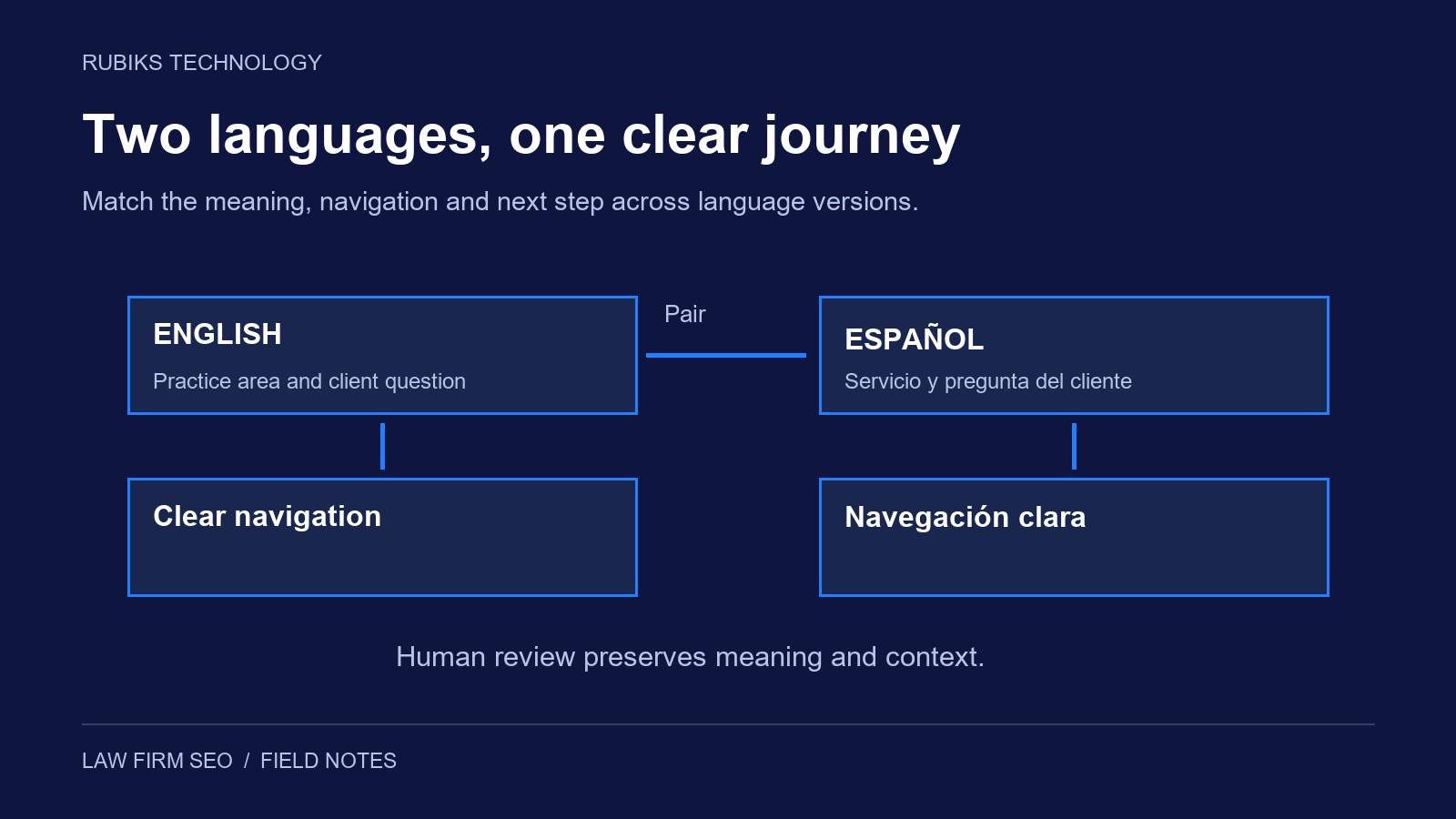
The market most law firm websites cannot speak to
In dozens of American metros, a meaningful share of the people searching for a lawyer are searching in Spanish. The U.S. Census Bureau’s language use data counts tens of millions of Spanish speakers at home, with over a third of residents in many Texas, Florida, California, and Arizona markets. These are people facing the same accidents, arrests, and immigration deadlines as everyone else, typing abogado de accidentes instead of accident lawyer. In most of those markets, the Spanish-language results are dramatically less competitive than the English ones, because most firms either ignore the demand or serve it with a translation widget that Google cannot rank.
That is the opportunity and the trap in one sentence. Spanish-language SEO done properly means real indexed pages, correct hreflang, and content written for the audience rather than run through a converter. Done casually it produces nothing, or worse, duplicate content problems. This post covers the architecture and the judgment calls, the way we approach them in our local SEO system for law firms.
First decide whether your firm should do this at all
Spanish pages earn their keep under two conditions. The market has real Spanish-language search demand for your practice areas, and the firm can actually serve a Spanish-speaking client who calls. The first condition is checkable, look at the census figures for your county and test the Spanish queries for your practice areas to see what ranks. The second condition is the one firms skip. If a Spanish speaker lands on your abogado page, calls, and reaches an English-only intake desk, you have paid to create a broken promise. The page generated the call and the intake experience lost the case, and the reviews that follow will say so in both languages.
Practice area matters too. Immigration, personal injury, workers compensation, and criminal defense carry heavy Spanish-language demand in most markets. Estate planning for high-net-worth clients, much less so. Firms in the first group with bilingual intake should treat this as a priority channel. We touched on the practice-specific version of this in our post on immigration lawyer marketing and multilingual SEO, and the logic there extends to every consumer practice area.
The widget trap, and why JavaScript translation does not rank
The most common implementation we find is a translation widget, GTranslate, Google Translate embeds, and their cousins, bolted onto an English site. The visitor clicks a flag and the page text swaps in the browser. For accessibility this is better than nothing. For SEO it is usually worth exactly nothing, because in the common free configurations there are no Spanish URLs for Google to crawl and index. The Spanish version of your car accident page does not exist as a page. It is a client-side costume on the English page, and Google ranks pages, not costumes.
Paid tiers of these tools can generate real translated URLs, which solves the indexing problem and immediately creates a quality problem, because what gets indexed is raw machine translation of legal content. Machine-translated pages published at scale without human review sit squarely in the category Google calls scaled content abuse, and in legal, where a mistranslated phrase can misstate someone’s rights, the risk is not only algorithmic. If the Spanish market is worth entering, it is worth entering with pages a bilingual human wrote or reviewed. If it is not worth that, a widget will not change the math.
There is a middle path worth naming. Some firms use machine translation as the first draft and pay a bilingual paralegal or attorney to review and correct every page before it goes live. That workflow is legitimate, cuts the cost of entry roughly in half, and produces pages a firm can stand behind. The line that matters is human review of every published sentence, because the liability and the trust both attach to what the page actually says.
Build real /es/ pages under one domain
The architecture that works for law firms is a subdirectory, yourfirm.com/es/, holding real Spanish pages that mirror your money pages. Not the whole site. Start with the practice areas where Spanish demand is proven, the contact page, and the attorney bios of whoever will actually take these calls. A subdirectory inherits the domain’s existing authority, which a separate Spanish domain would forfeit, and it keeps one site to maintain instead of two. Every Spanish page gets its own URL, its own Spanish title tag and meta description, and its own place in the navigation, findable by a visitor and crawlable by a bot without executing anything.
Structure inside /es/ should echo the silo logic of the English site, Spanish practice pages linking to related Spanish pages, so the section builds its own internal coherence. The same architectural rules apply in both languages, and the foundation work we covered in technical SEO for law firm websites, clean URLs, fast templates, crawlable links, carries over without modification.
Get hreflang right, because half-right is wrong
Hreflang is the annotation that tells Google your English and Spanish pages are language alternates of each other, so it can serve the right version to the right searcher and understand the pages are counterparts rather than duplicates. The rules are few and unforgiving. Every English page with a Spanish twin annotates both versions, using en for English and es for Spanish, and the annotation must be reciprocal. The Spanish page must point back to the English one, or the pair is ignored. Each page also includes a self-referencing hreflang tag, and pages without a counterpart get no annotation at all.
The failure pattern we see most is one-directional tags added by a plugin on the English side only, which Google silently discards. The second most common is pointing hreflang at redirected or noindexed URLs. Audit the pairs after launch in Search Console rather than assuming the plugin behaved. It is an hour of verification protecting the entire investment.
Resist the urge to overcomplicate the language codes. For a U.S. firm serving U.S. Spanish speakers, es is enough, and es-US is acceptable. What you should not do is copy a multinational template that declares es-ES and es-MX variants of pages that do not exist. Hreflang should describe the site you actually built, nothing more, and the simplest correct implementation beats the sophisticated broken one that most plugins produce on their default settings.
Transcreate the money pages, do not just translate them
Translation converts words. Transcreation converts intent, and legal marketing needs the second. A literal translation of your car accident page will read stiffly and miss how Spanish speakers in your market actually search and speak, including which terms they use for the practice area itself, abogado versus licenciado, accidente de carro versus accidente de auto, and the regional variations between a Mexican-heritage market in Texas and a Cuban-heritage market in Miami. Spanish keyword research is its own small project, and the search volumes will surprise you in both directions.
Transcreated pages should also answer the questions this audience actually asks, which are not always the English questions. Whether immigration status affects an injury claim is a first-page concern for many Spanish-speaking accident victims, and a page that addresses it directly and accurately will convert at rates a translated page never touches. Add the trust signals that matter here, bilingual staff named as such, community involvement, and reviews from Spanish-speaking clients. Your Google Business Profile should reflect the capability too, with Spanish in the languages attribute and Spanish review responses, an extension of the fundamentals in Google Business Profile optimization for attorneys.
Measure it as its own channel
Segment /es/ traffic separately in analytics and Search Console from day one, and tag intake so Spanish-language calls and forms are attributable to the pages that produced them. The early numbers will be small and the trajectory is what matters, Spanish impressions growing, queries appearing that no English page could earn, and the first signed case that entered through an abogado search. Firms that measure the channel keep investing in it, and in most markets the second mover advantage never arrives, because there is no second mover. The firm that builds the real Spanish section first tends to keep the market.
Set expectations on scope as well as speed. A five-page Spanish section covering your two highest-demand practice areas, built properly, will outperform a fifty-page machine-translated mirror in both rankings and cases, and it costs less to produce. Grow the section the same way you grew the English site, by following demand. When the Spanish accident page starts pulling queries about work injuries, the workers compensation page is next, and the Search Console data will keep handing you the roadmap one page at a time.
Open the second front in your market
If your county’s census numbers say a third of your potential clients search in a language your website does not speak, that is the clearest gap analysis you will ever get for free. We build Spanish-language sections as part of the local SEO engine, demand verification, architecture, hreflang, transcreated money pages, and tracking that proves the cases. Explore local SEO for law firms and book a strategy call with the Rubiks Technology team.