Article / July 28, 2026
Local Content Strategy for Law Firms That Earns Rankings Block by Block
Why local content decides who gets the call
When someone in your city searches for a lawyer, Google has two jobs. It has to figure out which firms are relevant to the problem, and it has to figure out which firms are genuinely part of that local market. The first job is handled by your practice area pages. The second job is handled almost entirely by your local content. A firm with strong practice pages but no local footprint on its website reads to Google like a national brand with a mailing address, and national brands rarely win local searches against firms that clearly live where their clients live.
Most law firms get this wrong in one of two directions. Either they publish nothing local at all, or they mass-produce thin city pages that say the same thing with the town name swapped out. Neither approach earns anything. A working local content strategy sits in the middle. It builds a limited number of genuinely useful local pages, each one tied to a real search someone in your market actually types, and each one connected to the rest of your site so the authority flows where it should. That is the approach we build into every local content strategy for lawyers, and this post walks through how it works.
Start with the searches, not the map
The instinct is to open a map, list every suburb within thirty miles, and assign each one a page. Resist it. Local content should start with search demand, because a page nobody searches for is a page that dilutes your site. Pull the queries your intake team hears on the phone. Look at the modifiers people attach to your practice area, things like near me, in your city name, cost in your county, court names, and neighborhood names. Then group them. You will usually find that demand concentrates in a handful of geographic terms and a longer tail of question-style searches with a local flavor.
Google has published research through its Think with Google consumer insights program showing how heavily consumers lean on locally qualified searches when they are close to making a decision, and legal services follow the same pattern. Someone searching for a divorce attorney in a specific neighborhood is much further down the funnel than someone reading about divorce in general. Your local content strategy should be weighted toward those decision-stage searches, because that is where signed cases come from.
The three layers of local content that actually rank
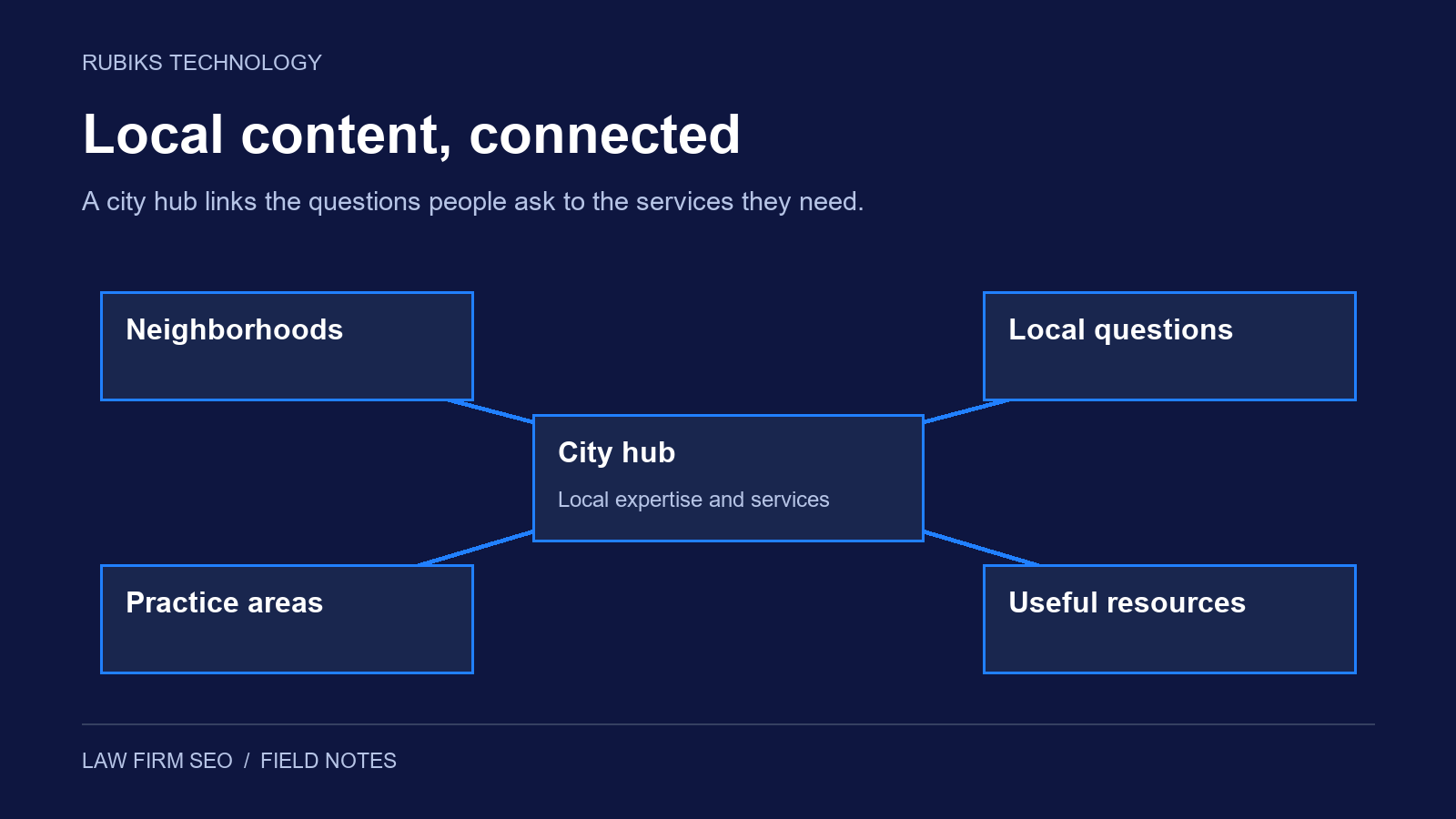
Once you know the demand, the content itself falls into three layers. The first layer is geo landing pages, one for each city or service area where you realistically compete. These are commercial pages. They exist to rank for the practice area plus location query and to convert. Done badly they become doorway pages, which is why we wrote a full breakdown of geo landing pages that rank without the doorway page risk. The short version is that every geo page needs substance that could only be true of that location, such as the courts it feeds into, the local process quirks, and the results the firm has produced there.
The second layer is local resource content. These are informational pages that answer the questions your market asks with local specifics baked in. What happens at an arraignment at your county courthouse. How long a divorce takes in your state and county. What the local filing fees are. These pages rarely convert directly, but they earn rankings, links, and trust, and they pass all of that to your commercial pages through internal links.
The third layer is proof content. Case results tied to local courts, community involvement, sponsorships, and local awards. This layer is small, but it does something the other two cannot. It gives Google and prospective clients third-party verifiable evidence that your firm is a real participant in the local market rather than a website targeting it from a distance.
Local content and the map pack work together
Local content is not just an organic play. The strength of your website’s local relevance feeds directly into how your Google Business Profile performs, because Google uses your landing page and site content as part of how it understands what your profile should rank for. Firms that pair a well-built profile with a real local content layer consistently outperform firms that treat the two as separate projects. If your profile is not pulling its weight yet, start with our guide to Google Business Profile optimization for attorneys and then make sure the pages your profile links to actually deserve the traffic.
The same logic applies to the local pack itself. Proximity, relevance, and prominence decide those three coveted spots, and local content is your biggest lever on relevance. We covered the full mechanics in our post on how law firms win the Google local pack, but the point worth repeating here is that the pack and the organic results reinforce each other. A firm that ranks organically for local queries tends to rise in the pack for the same queries, and vice versa.
How much local content is enough
Less than most agencies will sell you. A single-market firm usually needs one strong geo page per meaningful city, somewhere between three and eight in most metros, plus a resource layer of ten to twenty local informational pages built out over several months. Beyond that, additional local pages hit diminishing returns fast. The goal is coverage of real demand, not volume. Every page should be able to answer the question of who searches for this and why they would be glad they landed here.
Cadence matters more than quantity. Two well-researched local pages a month, published consistently and interlinked properly, will outperform twenty pages dumped in a single week and then abandoned. Google rewards sites that behave like living local resources, and clients can tell the difference between a page written by someone who knows the county courthouse and a page written by someone who found it on a map.
Structure decides whether local content compounds
The most common failure we see in law firm local content is not quality. It is structure. Firms publish decent local pages that float free in the blog with no parent, no siblings, and no links from the pages that already have authority. Those pages stall. Local content needs to live inside the site’s architecture, with geo pages sitting under the practice areas they support and resource content linking up to both. That is a core piece of the broader local SEO system we build for law firms, and it is the difference between local pages that compound and local pages that just accumulate.
A simple test tells you where you stand. Pick your most important geo page and count the internal links pointing to it from elsewhere on your site. If the answer is one or two, that page is being asked to rank on its own, and it will lose to a competitor whose equivalent page is woven into a real structure. Fixing the linking usually moves rankings faster than rewriting the content.
What good local content looks like on the page
It is worth being concrete about the difference between a local page that ranks and one that merely exists, because from a distance they look similar. Both have the city in the title tag, both mention the practice area, both end with a phone number. The differences live in the middle. The page that ranks names the actual courthouse where these cases get heard and explains what happens there. It references the local statute of limitations rather than a national generalization. It anchors claims in local experience, cases handled in that county, familiarity with the local prosecutors or judges where that is appropriate to say, and results earned in that venue. It reads like it was written by someone who has parked at that courthouse.
The page that merely exists talks about the city instead of about practicing law in the city. It pads word count with population figures, founding dates, and lists of neighborhoods copied from a tourism site, none of which a person facing a legal problem cares about. Google has become very good at telling these apart, partly because users tell it. A visitor who lands on a padded city page bounces back to the results in seconds, while a visitor who finds the specific answer stays, reads, and calls. Write every local page for the second visitor and the ranking tends to follow the behavior.
A useful discipline is to require one piece of information on every local page that could not appear on any other page of your site. If the page for one suburb could become the page for the next suburb with a find-and-replace, it fails the test, and it will fail with Google for the same reason. This standard slows production down slightly and improves outcomes enormously, which is a trade every firm should be happy to make.
Measure local content like the investment it is
Local content earns its budget when you can trace it forward to consultations. Set up tracking so each geo page and resource page reports its own organic entrances, calls, and form fills, and review the set quarterly. Expect a power-law distribution. A few pages will carry most of the volume, a middle band will contribute steadily, and a tail will do little. The correct response to the tail is usually improvement or consolidation rather than deletion, since even quiet local pages contribute relevance to the silo they sit in. What you are really watching for is direction. A local content layer that is six months old and producing zero attributable contacts has a targeting problem or a structure problem, and the fix starts with rechecking demand rather than writing more pages.
Put a real local content plan behind your firm
If your firm’s local visibility depends on a Google Business Profile and hope, there is a structured way to fix that. Our local content strategy work maps the actual demand in your market, builds the geo and resource layers to serve it, and wires everything into an architecture that compounds instead of fragmenting. To see what that would look like for your market, explore our local content strategy for lawyers service and book a strategy call with the Rubiks Technology team.