Article / July 31, 2026
Law Firm Homepage SEO, the Anatomy of a Homepage That Ranks and Converts
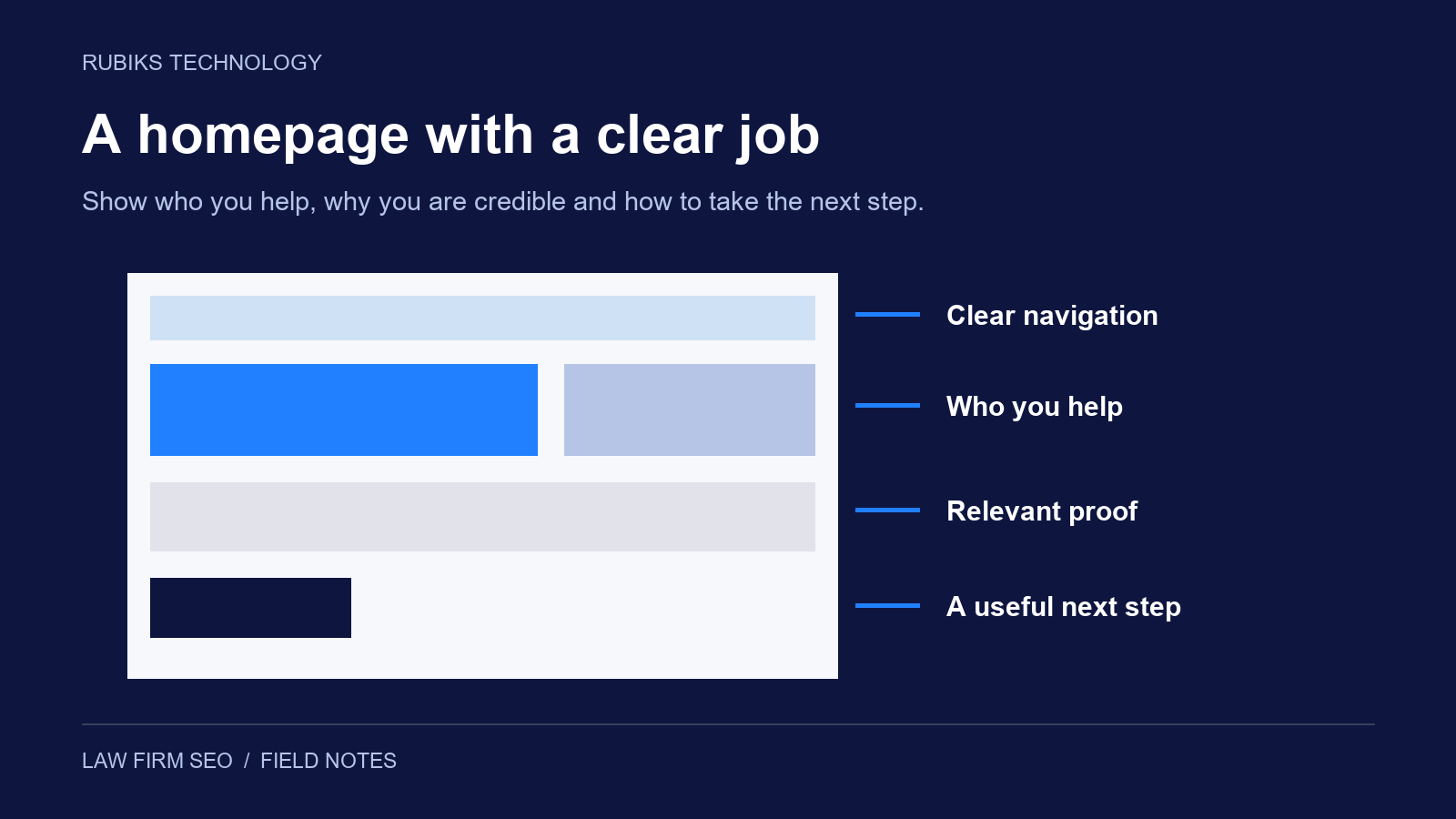
The most powerful page on your site is usually the most wasted
On almost every law firm website, the homepage holds more link equity than any other URL. It collects the links from directories, news mentions, bar profiles, and every citation that points at the root domain. It is also the page most prospective clients will see at some point before they call, even the ones who entered through a blog post. And on most firm sites, this powerhouse says almost nothing. A stock photo of a courthouse, a slogan about fighting for you, a slider nobody watches, and a wall of practice area icons. The strongest page on the site, spent on wallpaper.
Homepage SEO for law firms is the work of giving that equity a job. Done right, the homepage ranks for the firm’s core market terms, routes visitors and authority into the practice pages, and closes the trust gap for every referral who Googles your name before dialing. This post walks through the anatomy section by section, the same way we build it inside Core30 for law firms.
Decide what the homepage targets, because it cannot target everything
The first decision is the keyword assignment, and it is where most firms go wrong in one of two directions. Some optimize the homepage for nothing but the firm name. Others try to make it rank for every practice area at once, stuffing personal injury, divorce, criminal defense, and estate planning into one title tag until it ranks for none of them. The right target for most firms is the firm’s category plus its city. A firm that is genuinely one thing, like a personal injury shop, points the homepage at personal injury lawyer plus city. A true multi-practice firm points it at law firm plus city and lets the practice pages carry the specific terms.
That assignment has consequences for the rest of the site. If the homepage owns the broadest term, no other page should compete for it, and every practice page should own its own term cleanly beneath it. This is the hub and spoke logic we laid out in why law firm websites need silo architecture, with the homepage as the hub above the hubs. Multi-practice firms that skip this decision end up with a homepage fighting its own practice pages, which is the on-site equivalent of two partners bidding against each other at auction.
The first screen decides whether anyone reads the second
Above the fold, a law firm homepage has three jobs and about five seconds. Say who you are and what you do in plain words, personal injury lawyers in your city, not advocates for the injured. Prove you are local and real, which the city name in the headline accomplishes. And present one obvious action, a phone number and a consultation button that are visible without scrolling on a phone. Stanford’s Persuasive Technology Lab distilled a decade of research into its Web Credibility Guidelines, and the findings map directly onto this screen. People judge whether a site is trustworthy from immediate surface signals, real organization details, easy verification, and visible people, before they read a single paragraph, and everything below the fold exists only for the visitors that first screen convinces to stay.
Note what is absent from that list. No slider, because sliders push your one message off screen in rotation. No autoplay video backgrounds that cost three seconds of load time. Speed is part of the first screen too. The homepage is often the heaviest page on a firm site and the one most in need of the discipline we described in technical SEO for law firm websites.
The middle of the page is a routing layer, not a brochure
Below the fold, the homepage’s main structural job is distribution. A practice areas section with a short, specific blurb for each area and a real text link into each practice page does two things at once. It moves visitors toward the page that matches their problem, and it passes the homepage’s concentrated link equity into the pages that need it to rank. These links should be crawlable HTML links with descriptive anchors, car accident lawyers rather than learn more, because the anchor text is part of what the equity carries.
Keep the list honest. Eight practice areas with substance beat twenty icons linking to thin pages. And resist the urge to make every section link back to the contact page. The homepage converts best for visitors who are ready, but its measurable SEO value flows through the internal links, and diluting them across forty navigation items weakens what each one passes. A firm that treats the homepage as the top of its routing system will feel the effect on practice page rankings within months.
The routing layer is also where local proof belongs for multi-city firms. A short service area section naming the cities and counties you actually serve, each linked to its geo page where one exists, extends the same distribution logic to the local layer. Keep it factual and specific, the counties, the courts, the offices, because a paragraph of city name stuffing does the opposite of what firms hope. One honest sentence per market with a link beats a hundred comma-separated town names every time.
Stack the proof where the skeptics scroll
The visitors who scroll past the practice area grid are the skeptics, and the lower half of the homepage exists for them. This is where proof lives. Real case results with numbers where your bar rules allow them. Attorney photos and names, linked to bio pages, because people hire people. Recognitions that mean something, super lawyers listings, board certifications, verdicts reported in the press. And reviews, pulled from the platforms clients actually check, presented with attribution. If your review engine is thin, that is its own project, and the compliant way to fix it is the process we documented in bar-compliant review generation for law firms.
Proof sections also carry SEO weight beyond conversion. Named attorneys, credentials, and results are exactly the kind of verifiable signals Google’s quality systems look for on pages where trust matters, and legal is the canonical case. A homepage that shows who the lawyers are, what they have won, and what clients say is answering the quality question and the client’s question with the same content.
The technical layer most law firm homepages miss
A few technical items concentrate on the homepage specifically. Schema markup belongs here, LegalService or Attorney structured data with the firm’s name, address, phone, hours, and geo coordinates, matching the Google Business Profile exactly. The title tag should lead with the target term, not the firm name, unless the firm name itself carries search demand. The NAP in the footer should match every citation you own character for character. And the homepage should be the canonical, unique root, with no www and non-www duplication, no http and https split, and no campaign or stray parameter versions competing with it.
Check what actually points at the homepage too. Old campaigns, directory profiles, and email signatures sometimes link to variants that redirect or, worse, do not. Every one of those is equity leaking before it arrives. Fifteen minutes in a crawl tool usually surfaces the whole list.
One more silent leak is worth checking while you are in there. Many firm sites have accumulated multiple quasi-homepages over the years, an old /home/ URL, a /welcome/ page, an index.php variant that still resolves. Each one Google indexes is a competitor to your real root, splitting signals that should concentrate. Redirect the strays, pick one canonical root, and let a decade of accumulated authority finally point at a single URL.
How to tell if your homepage is doing its job
Three checks give you the verdict. First, search your firm’s category plus city and see whether your homepage appears and where. Second, look at internal link flow in a crawler and confirm the practice pages receiving homepage links are the ones you need to rank. Third, watch homepage behavior in analytics, where a healthy firm homepage shows visitors flowing into practice pages and contact actions rather than bouncing. If the homepage ranks for nothing, routes nothing, and converts nothing, it is not neutral. It is actively hoarding the authority your money pages are starving for, and rebuilding it moves numbers across the whole site. Rebuilds are also the moment conversion gets designed in rather than bolted on, which is the discipline behind our law firm website CRO work.
Make your strongest page act like it
If your homepage is a slideshow with a slogan, you are paying for rankings your own site refuses to accept delivery on. We rebuild law firm homepages as ranking and routing assets inside the Cube30 system, keyword assignment, structure, proof, schema, and the internal links that push authority where cases come from. See how Core30 for law firms works and book a strategy call with the Rubiks Technology team.