Article / July 29, 2026
Keyword Research for Law Firms That Starts With Cases, Not Search Volume
Why law firm keyword research goes wrong before it starts
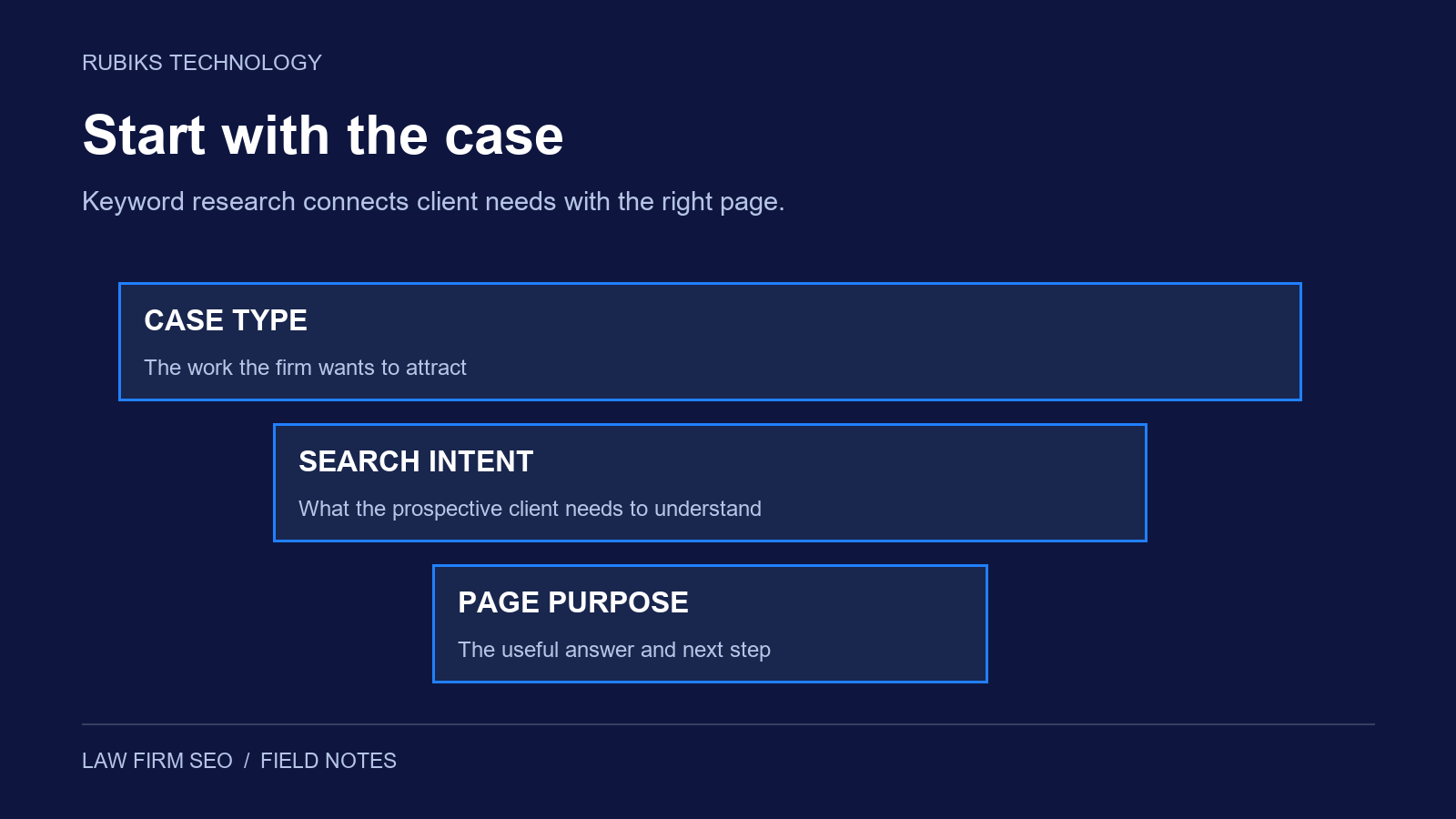
Most law firm keyword research begins in a tool and ends in a spreadsheet nobody uses. An agency exports two thousand keywords, sorts them by search volume, and hands the firm a list dominated by terms it can never rank for and terms that would never produce a client if it did. The problem is not the tool. The problem is starting with volume instead of starting with cases. A criminal defense firm does not need traffic. It needs the forty people in its county this month who were just arrested and are holding a phone. Keyword research done properly is the process of finding out exactly what those people type, and building the shortest possible list of pages that answers them.
This is why we treat keyword research as the foundation layer of the Core30 content system for law firms rather than a one-time deliverable. The keyword map decides what pages exist, what each page is allowed to target, and how they connect. Get it right and every page has a job. Get it wrong and you spend a year publishing content that competes with itself.
Start with the practice area grid
The backbone of every law firm keyword map is a simple grid. Down one side, list every practice area and sub-practice the firm actually wants cases in, at the level of specificity clients use. Not just personal injury, but car accidents, truck accidents, slip and fall, dog bites. Not just family law, but divorce, custody, child support, prenups. Clients search at the sub-practice level far more often than the umbrella level, and sub-practice terms are both easier to rank for and closer to a signed case.
Across the top, list the formats a search can take. The head term itself, the lawyer or attorney variant, the near me variant, and the city variant. That grid alone usually produces the firm’s entire commercial page list, and it exposes gaps immediately. If the firm signs truck accident cases but has no truck accident page, no amount of blogging fixes that. This is the same exercise that drives a proper law firm content inventory, run in reverse. The inventory tells you what exists, and the grid tells you what should.
Layer in the local modifiers that decide real rankings
Legal search is local search. The person typing rarely wants the best divorce lawyer in the country. They want one they can drive to. That means every commercial keyword needs its local variants mapped, which include the city, the county, the neighborhood in larger metros, and sometimes the courthouse itself. Criminal defense and DUI searches in particular attach to court names and county names, because that is how defendants think about their problem.
Be deliberate about which locations earn their own page and which get folded into a parent. A firm in a mid-size metro might justify pages for three to six surrounding cities per practice area, and no more. Beyond real demand, additional geo variants become thin pages that drag the site down. We covered how to make the cut safely in our guide to geo landing pages that avoid doorway page risk, and the keyword map is where that decision gets made. If you cannot find evidence that people in a town search for your practice area plus that town, the town does not get a page. It gets a mention.
Sort every keyword into an intent tier
The single most useful thing you can do with a law firm keyword list is tag each term with the searcher’s distance from hiring. We use three tiers. Tier one is hire intent, terms like car accident lawyer near me, DUI attorney in your city, and best divorce lawyer plus location. These searches happen when someone has decided they need representation and is choosing whom to call. They belong on practice area and geo pages, never on blog posts.
Tier two is problem intent. The searcher knows something is wrong but has not decided a lawyer is the answer. What to do after a car accident, can I get custody if I move out, how long after an accident can I sue. These map to supporting content that educates and then routes the reader toward the relevant practice page. Tier three is research intent, broad informational terms with high volume and low proximity to a case. Most firms should target very little of tier three, because it consumes writing budget that tier two spends far better.
Ahrefs publishes a thorough walkthrough of classifying queries this way in its keyword research guide, and the mechanics apply cleanly to legal. The legal-specific twist is how steep the value curve is. A tier one legal click can be worth hundreds of dollars, which is why competition on those terms is brutal and why tier two content that feeds them internally is the realistic path for most firms.
Read the results page before trusting any keyword
Volume numbers for legal terms are estimates at best, and for low-volume local terms the tools often show zero for queries that produce real calls every month. The more reliable read is the search results page itself. Type the keyword and look at what Google chose to rank. If the page one results for a term are all practice area pages, Google has decided the intent is commercial, and a blog post will not crack it. If they are all articles, the reverse is true. If a map pack appears, the term has local intent and your Google Business Profile is part of the fight, which connects keyword research directly to the work in our local SEO system for law firms.
The results page also tells you the level of competition honestly. If every result is a national directory or a firm with ten times your backlink profile, that keyword is a long-term ambition, not a quarter-one target. A good keyword map marks each term as winnable now, winnable in a year, or aspirational, and sequences the work accordingly.
While you are on the results page, harvest what Google volunteers. The people also ask boxes, the autocomplete suggestions, and the related searches at the bottom are all real queries pulled from real behavior in your market, and they routinely surface phrasings no export catches. A DUI results page in one county will suggest questions about license hearings, in another about ignition interlocks, and those differences are your content plan telling you what it wants to be. Ten minutes of this per keyword produces better supporting topics than an hour in a tool, because the source is the searchers themselves rather than a model of them.
Turn the list into a page map, one keyword cluster per page
The output of keyword research is not a keyword list. It is a page map. Every page on the site gets assigned one primary keyword and a small cluster of close variants, and no two pages are allowed to share a primary target. This rule sounds obvious and is violated on almost every law firm site we audit. The car accident practice page targets car accident lawyer, then three old blog posts also target car accident lawyer, and Google is left to guess which one matters. The guess is usually wrong, and the pages split authority four ways.
Assigning clusters also settles the question of what each page should say. A page owns its primary term, its variants, and the questions searchers ask around it, and the on-page work flows from that assignment. Our post on on-page SEO for attorney practice area pages covers the execution side. The keyword map is what makes that execution coherent across fifty pages instead of one.
Revisit the map quarterly, not annually
Search demand in legal shifts more than firms expect. New statutes create new queries, a local news story spikes a practice area, a competitor starts winning a term you owned. A keyword map that was accurate in January degrades quietly by summer. The maintenance work is light if it is regular. Each quarter, check rankings against the map, look for queries in Search Console that no page owns, and check whether any tier two topic has started showing commercial results. Fifteen new queries with no owner is next quarter’s content plan, already prioritized by evidence instead of guesswork.
This cadence also protects you from the biggest silent failure in legal content, which is writing to keywords that stopped mattering. Firms that skip the review keep publishing into topics because they sit on the old list, while the actual demand has moved elsewhere. The map is a living document. Treat it like the docket, not like the diploma on the wall.
Build your firm’s keyword map with Rubiks
If your firm’s content plan is a list of blog ideas rather than a page map built from real demand, that is the gap between publishing and ranking. Our Core30 engagements start with exactly this work, a full practice area grid, local modifier mapping, intent tiers, and a page-by-page target assignment the whole site follows. To see what your market’s map looks like, explore Core30 for law firms and book a strategy call with the Rubiks Technology team.