The honest answer and why nobody leads with it
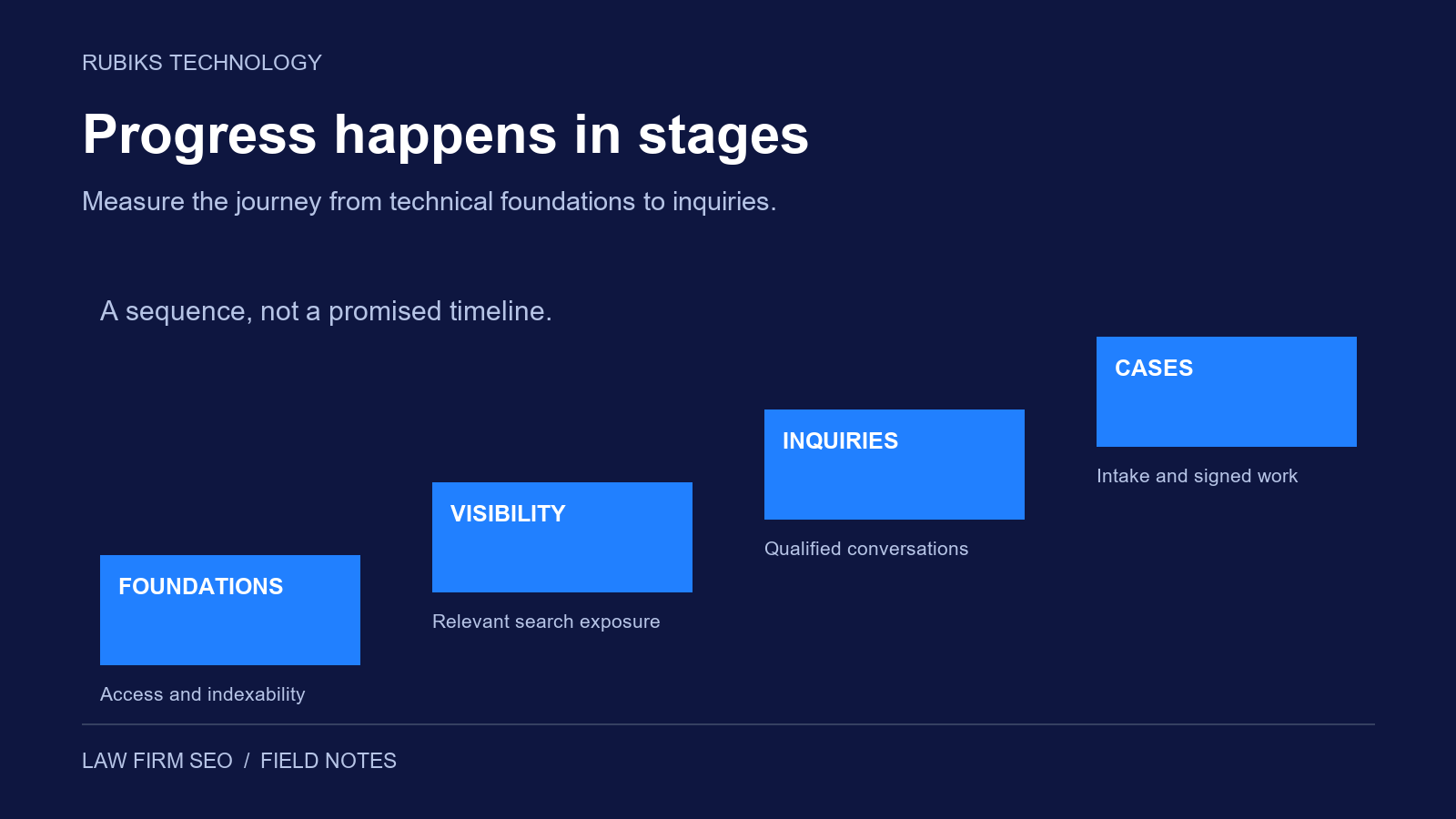
Most law firms start seeing meaningful movement from a properly executed SEO campaign between month four and month six, and meaningful case flow between month six and month twelve. Competitive practice areas in major metros sit at the long end, and firms starting with a healthy site in a smaller market sit at the short end. That is the honest answer, and the reason few agencies lead with it is that a twelve-month horizon is harder to sell than a ninety-day promise. But the firms that get burned in this industry are almost always the ones that bought the ninety-day promise.
Understanding why the timeline looks the way it does matters more than the number itself, because it tells you what to inspect at each stage and when to worry. This post lays out the phases as we run them inside our law firm SEO agency engagements, the variables that stretch or compress the curve, and the early indicators that separate a campaign that is working from one that is stalling politely.
Months one and two are groundwork, not rankings
The first sixty days of a serious campaign are diagnostic and structural. A full technical and content audit, an inventory of every existing page, keyword and competitor research, architecture planning, and the unglamorous repair work that makes everything later possible. Rankings rarely move in this window, and they should not be expected to. What you should expect is visible output. A completed audit with findings you can read, a topic map you can question, and a prioritized plan with dates. We detailed what that first deliverable should contain in what a real law firm SEO audit actually covers, and if your agency’s month one produced nothing resembling it, the timeline conversation is already off track.
Groundwork pace depends heavily on your starting position. A firm dragging ten years of duplicate pages, a slow theme, and a penalty-adjacent link profile has more to repair than a firm with a clean two-year-old site. This is the single biggest reason two firms buying the same service see different timelines, and it is knowable up front from the audit.
Months three through six are where compounding starts
With the foundation fixed, new and rebuilt pages start entering the index, the silo structure begins concentrating authority, and long-tail rankings appear first. This is the phase where the leading indicators show up well before the phone rings more. Impressions climb in Search Console, rankings for specific question-style queries reach page one, and the first geo terms move from page three to page two. Case flow usually lags these signals by a quarter, because the money terms are the last to move and the map pack often turns before the organic money terms do.
Google itself has been consistent on this horizon for years. The company’s own search documentation and its public guidance for hiring SEO help both warn that most changes take months to show their full effect and that firms promising immediate rankings are a red flag. Independent research backs up the compounding pattern. The U.S. Small Business Administration’s guidance on marketing and sales for small businesses treats organic visibility as a long-horizon asset to be built alongside faster channels, not a faucet you turn on, and that framing matches what the data shows in legal, one of the most competitive verticals there is.
What actually controls your position on the curve
Five variables explain most of the variance between the fast and slow ends of the timeline.
- Market competitiveness. Personal injury in Houston and estate planning in a mid-size town are different sports.
- Starting authority. Domain age, existing links, and existing rankings are a head start or a deficit.
- Site health. Technical debt and content debt each add months if they are severe.
- Execution velocity. Two quality pages a month versus eight changes the slope directly.
- Approval speed. Firms that sit on content drafts for three weeks add those three weeks to their own timeline, every cycle.
Notice that two of the five are inside the firm’s control. The agencies with the best timelines usually have the clients with the fastest feedback loops. If you want the shorter end of the curve, budget for velocity, and read our breakdown of how much law firm SEO costs in 2026 to see how spend level maps to pace.
The checkpoints that tell you it is working
You do not need to wait a year to know whether a campaign is on track. By the end of month two you should have the audit, the map, and completed technical fixes you can verify. By month four, rising impressions and a growing set of long-tail page-one rankings. By month six, movement on mid-difficulty terms, early map pack improvement, and the first attributable consultations. By month nine, money-term rankings in striking distance and a case pipeline you can trace to search. Each checkpoint missed without a specific, evidenced explanation is a signal, and three missed checkpoints is a verdict.
Be equally careful with the opposite signal. A vendor showing spectacular movement in week six is usually showing you something other than durable progress, rankings for invented long-tail phrases, a rank tracker configured to flatter, or in the worst cases tactics that borrow against the site’s future. Legitimate campaigns occasionally catch an early break, a quick technical fix on a site that was strangling itself can move things fast, but the audit will have predicted that possibility in advance. Speed that nobody predicted and nobody can mechanically explain deserves more scrutiny than slowness that was forecast, because the expensive failures in this industry are almost never the slow campaigns. They are the fast ones that reversed.
Insist on reporting that makes these checkpoints visible in terms of cases and dollars rather than dashboards of sessions. The reporting framework we use ties every stage to signed-case economics, which is the standard we argued for in measuring law firm SEO ROI in signed cases. When the reporting is built that way, the timeline question answers itself month by month instead of remaining a matter of faith.
What to do while you wait for the compounding
A twelve-month horizon does not mean twelve months without cases from marketing. The sensible play for most firms is a bridge strategy. Paid search and Local Services Ads carry lead flow in the near term while the organic asset is under construction, with the paid budget deliberately tapering as organic case flow replaces it. Firms that run this sequence often find their blended cost per case dropping every quarter, because each organic case that displaces a paid one takes its acquisition cost close to zero. The mistake is treating paid and organic as competing line items when they are phases of the same transition.
The waiting period is also when the firm-side work happens, and it is worth doing because it shortens the visible part of the curve. Gathering reviews consistently, feeding the agency real case results and attorney credentials for content, responding to draft approvals inside a week, and getting intake ready for the volume that arrives in the back half of the year all compound the campaign’s effect. We have watched two firms in the same market buy comparable campaigns where one treated it as a vendor relationship and the other treated it as a joint project, and the joint-project firm reached case flow a full quarter earlier on the same spend.
One more thing to do while waiting is to lock the measurement baseline now. Record current organic traffic, current rankings on your ten money terms, current monthly consultations by source, and current cost per signed case from paid channels. Six months in, those baseline numbers are what turn the is-this-working conversation from feelings into arithmetic.
Why the slow start is the reason it works
The months of groundwork are not a tax on the results, they are the source of them. Paid ads produce leads on day one and stop the day the budget stops. Structured SEO produces little in month one and then produces compounding returns for years, because rankings earned through real architecture and authority do not reset when the invoice does. The firms that dominate their markets organically are almost never the ones that found a faster trick. They are the ones that started the twelve-month clock earlier than their competitors and kept it running. The structured approach behind that compounding is exactly what the Cube30 framework was built to systematize.
Start the clock with a plan you can inspect
If you are weighing SEO against another quarter of undifferentiated ad spend, the real question is where you want to be in a year. Our engagements begin with the audit and topic map, so you see the full route and every checkpoint before committing to the journey. To get a realistic timeline for your specific market and starting position, explore our law firm SEO agency services and book a strategy call with the Rubiks Technology team.