Most law firm websites are attics, not libraries
Open the sitemap of a ten-year-old law firm website and you will usually find the same thing. Hundreds of URLs, a blog full of posts nobody has looked at since the month they were published, three near-identical pages about car accidents written by three different marketing vendors, and a handful of pages quietly earning almost all of the traffic. The site is an attic. Things were added, nothing was ever removed or organized, and nobody currently at the firm knows exactly what is up there.
That matters because Google evaluates your site as a whole. Thin, redundant, and outdated pages do not just sit there harmlessly. They dilute topical focus, split ranking signals across duplicate pages, and drag down the perceived quality of everything else. Before a firm invests another dollar in new content, it should know what it already owns and how those assets map to the searches it wants to win. That is what a content inventory and a topic map deliver, and it is why they are the first working documents in our law firm content inventory and topic mapping engagements.
What a content inventory actually is
A content inventory is a complete, honest audit of every indexable URL on your site with the data needed to make a decision about each one. For every page you record what it targets, what it currently ranks for, how much traffic it earns, what links point to it internally and externally, when it was last updated, and whether anything else on the site competes with it. The output is not a spreadsheet for its own sake. It is a decision sheet where every row gets one of four verdicts.
- Keep, for pages that earn their place as they are.
- Improve, for pages targeting the right topic but underperforming on quality, depth, or structure.
- Consolidate, for duplicate or overlapping pages that should be merged into one stronger page with redirects.
- Remove, for pages with no target, no traffic, no links, and no plausible future.
On most law firm sites we audit, somewhere between thirty and fifty percent of URLs land in the last two categories. Consolidating them almost always lifts the surviving pages, because signals that were split across four weak pages now support one strong one. The industry press has documented this pattern for years, and the guides published by Search Engine Land treat content auditing as a standing pillar of technical and content SEO rather than a one-time cleanup, which matches what we see in practice.
What a topic map adds on top
The inventory tells you what you have. The topic map tells you what you should have. It is a structured list of every topic your firm needs to own to dominate its practice areas and market, organized by silo, with each topic assigned a target keyword, an intent, a page type, and a parent page it supports. When the map is done, every future piece of content has a predetermined place in the architecture before a word is written. Nothing gets published because someone had an idea on a Tuesday.
The map has a hierarchy for a reason. Practice area pages sit at the top of each silo and target the money terms. Supporting pages and posts target the longer, more specific questions underneath, and each one links up to its parent. That structure concentrates authority on the pages that sign cases, which is the whole argument we laid out in why law firm websites need silo architecture. A topic map without a silo structure is just a list of blog ideas. A topic map built onto a silo structure is a construction plan.
How the two documents work together
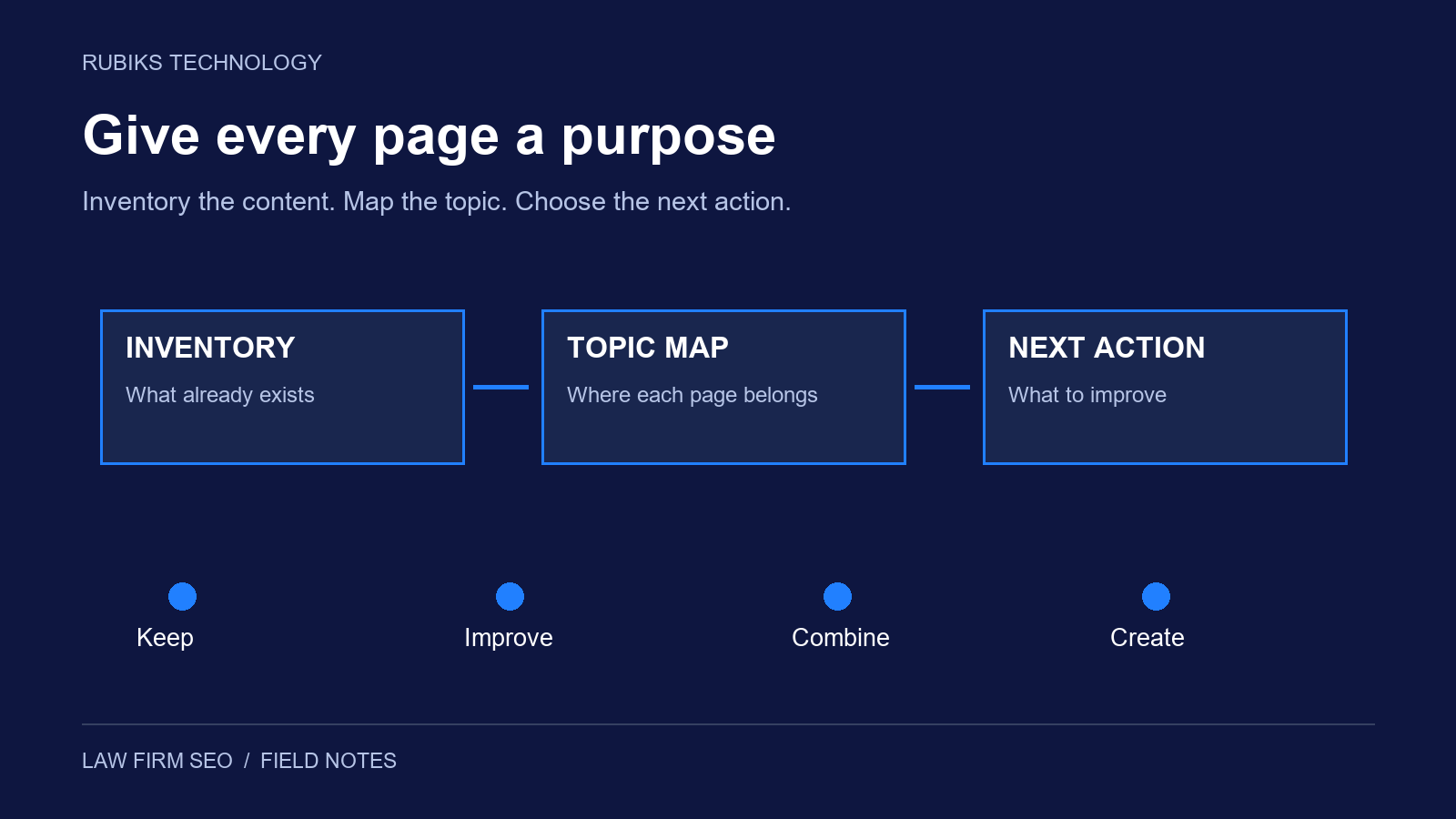
The real leverage appears when you lay the inventory over the map. Every existing page either claims a spot on the map or it does not. Pages that claim a spot get kept or improved to fully serve that topic. Pages that overlap a spot another page already serves get consolidated. Pages that fit nowhere get removed or redirected. And every empty spot on the map becomes a line in the content queue, prioritized by how much revenue the parent silo represents.
This is the step most firms and most agencies skip. They audit without a map, which produces cleanup with no direction, or they plan content without an inventory, which produces new pages that cannibalize old ones. Run together, the two documents turn content from a recurring expense into an asset ledger. You know what you own, what it is worth, what is missing, and what to build next. Within the Cube30 framework, this pairing is the content face of the cube, and everything else in the system depends on it being done honestly.
A worked example from a typical firm
Consider a personal injury firm with 240 indexed URLs. The inventory finds six pages about truck accidents written between 2016 and 2024, each thin, each ranking somewhere between position 20 and 50, none linking to the others. The topic map says the firm needs one authoritative truck accident page under the personal injury silo, supported by four specific subtopics such as underride crashes, federal trucking regulations, black box evidence, and trucking company liability. The action is obvious once both documents exist. Merge the six old pages into one strong parent with 301 redirects, write the four supporting pages, and link them all correctly.
Six months later that cluster typically ranks in a way six scattered pages never could, because the signals stopped competing with each other and started compounding. Multiply that pattern across every practice area and you understand why an inventory and map so often outperform a year of publish-and-pray blogging, at a fraction of the content spend.
How to run the inventory without boiling the ocean
The process is straightforward enough that the main risk is overcomplicating it. Start with a full crawl of the site to capture every indexable URL, then join that list against Search Console data for impressions and clicks, analytics data for entrances and conversions, and a backlink export for referring domains. That gives you one row per URL with the four or five columns that actually drive decisions. Resist the urge to add twenty more columns. The inventory exists to produce verdicts, and every column that does not change a verdict is decoration that slows the work down.
Render the verdicts in a working session with someone who knows the firm’s practice mix, because the data alone cannot tell you that a zero-traffic page about a niche practice area is strategically important, or that a high-traffic old post attracts entirely the wrong audience. Expect the whole exercise to take two to four weeks for a typical firm site, including the consolidation and redirect work. It is a bounded project with a clear end state, not a permanent committee, and firms that treat it as a one-quarter sprint get almost all of the value.
Plan to refresh the inventory annually rather than rebuilding it. Once the first pass has cleared the debt, the yearly update is a light review of what was published, what moved, and what new overlaps crept in. Sites that keep this discipline never again reach the attic state that made the first pass painful, which is the quiet payoff of the whole system.
The topic map is also a budgeting instrument
One underrated effect of a finished topic map is what it does to the marketing budget conversation. When the map shows forty empty slots across three silos with the revenue value of each parent page attached, content spend stops being an act of faith and becomes a capital allocation decision. The firm can see exactly what a given monthly budget buys in terms of map coverage, and exactly which silo gets fortified first and why. It also disciplines vendors. An agency working from a map cannot pad months with whatever was easy to write, because every deliverable has to land on a named coordinate. If your current provider cannot show you the map your content is being built against, that absence is itself a finding.
Signs your firm needs this now
You need an inventory and topic map if more than one page on your site targets the same core search, if your blog has more than fifty posts and you cannot name the last one that produced a consultation, if traffic is flat despite regular publishing, or if you have been through two or more marketing vendors who each left a layer of content behind. Any one of those signs means your site has accumulated structural debt, and new content poured on top of structural debt underperforms no matter how good it is. An honest law firm SEO audit will surface the symptoms, and the inventory and map are how you cure them.
Turn your content into an asset ledger
If nobody at your firm can say exactly what your website contains and why, that is the problem to fix before anything else. Our content inventory and topic mapping process catalogs every URL, renders a verdict on each, and produces a silo-based map that dictates everything you build for the next year. To get that clarity for your site, explore our law firm content inventory service and book a strategy call with the Rubiks Technology team.