Article / July 30, 2026
Competitor Analysis for Law Firm SEO, Reverse-Engineering the Firms Above You
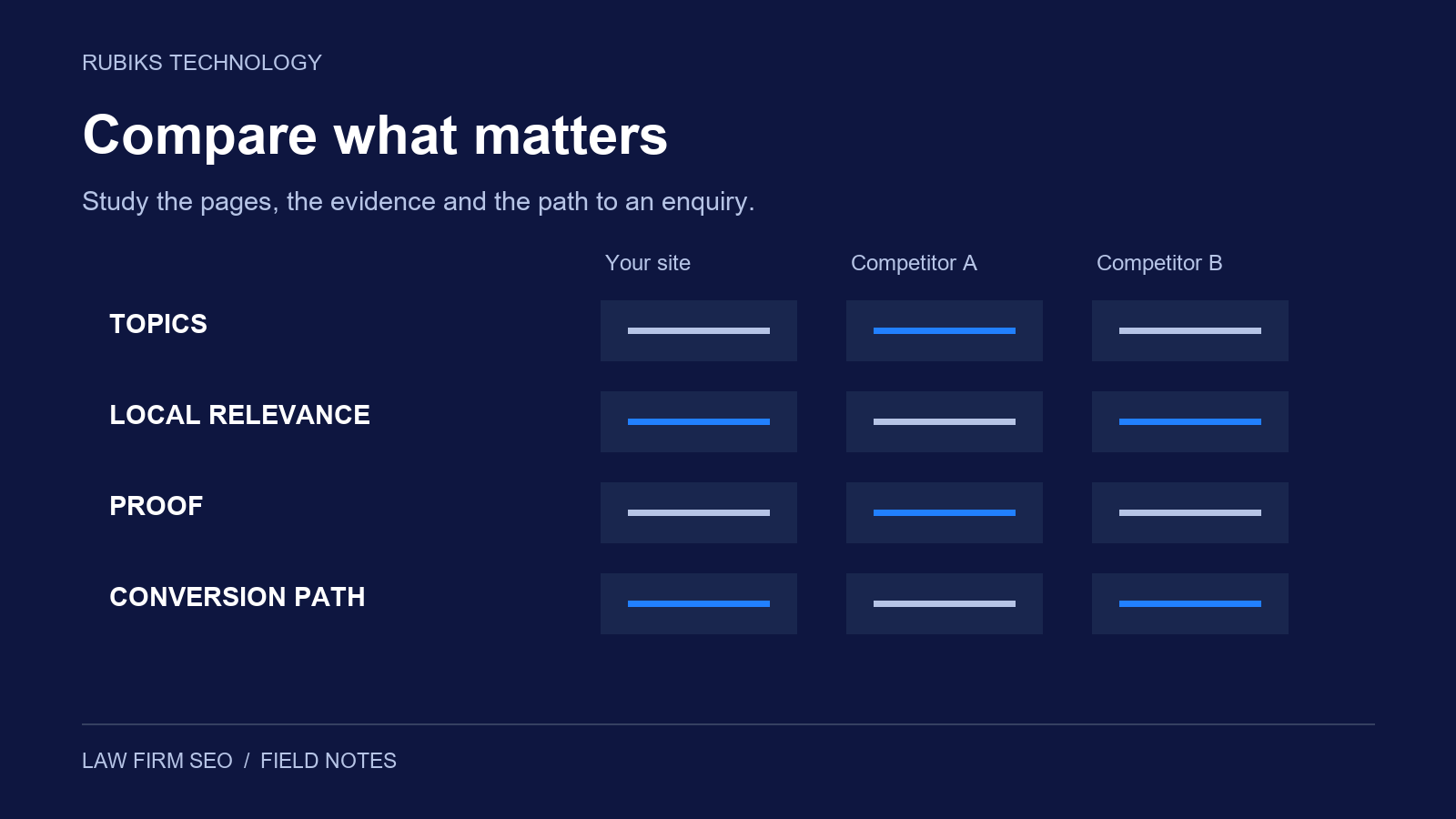
Your competitors already ran the experiment for you
Every law firm wants to know what it takes to rank in its market, and the honest answer is sitting in plain sight. The firms occupying page one have already run the experiment. Their pages, their links, their site structure, and their review profiles are a public record of what Google currently rewards for your exact keywords in your exact city. Competitor analysis is the discipline of reading that record properly instead of guessing, and it is the fastest way to replace opinions about SEO with evidence.
Most firms skip this step or do it badly. They glance at a rival’s website, decide it looks worse than their own, and conclude the rankings are unfair. Design is not what Google is rewarding. The analysis that matters happens under the hood, and this post walks through how we run it inside every engagement at our law firm SEO agency.
First, identify your real search competitors
Your business competitors and your search competitors are usually different lists. The firm across the street that steals your referrals may be invisible in Google, while a firm you have never heard of owns every keyword you want. Build the list from the results pages themselves. Take your ten most valuable queries, search them the way a client would, and record every domain that appears in the top ten organic results and the map pack. Firms that show up for four or more of your queries are your real rivals. Directories like Avvo and FindLaw will appear too. Note them, but analyze them separately, because you beat directories with different tactics than you use against firms.
Run this for both result types. The organic list and the map pack list often differ, and the map pack has its own rulebook built on proximity, categories, and reviews. We broke down that side of the fight in our post on how law firms win the Google local pack, and the competitor set you find there deserves its own column in your analysis.
Reverse-engineer their pages, not their homepage
For each keyword you care about, open the exact page the competitor ranks with and study it as a document. What is the title tag promising. How many words does the page carry, and what subtopics does it cover that yours does not. Does it name courts, statutes, and local process details, or is it generic. Does it show case results and attorney credentials on the page itself. How many internal links point into it, and from where. In legal SERPs the ranking page is rarely the homepage, and the gap between your page and theirs is usually specific and fixable once you see it itemized.
Do this across five or six competitors and patterns emerge fast. Maybe every ranking DUI page in your metro includes a license consequences section and yours does not. Maybe all of them sit inside a tight practice area silo while your equivalent page floats alone. Site structure comparisons are especially revealing, because structure is invisible to casual inspection but decisive for rankings. If the winners all run hub and spoke architectures, that is your evidence for the case we made in why law firm websites need silo architecture.
Compare link profiles to size the authority gap
Content parity gets you into the conversation. Authority decides who wins it. Pull each competitor’s backlink profile in a tool and look past the raw counts to the composition. How many referring domains do they have compared to you. Which links look like the difference makers, local news coverage, bar association profiles, law school pages, chambers of commerce, sponsorships. Which directories do they all share that you are missing. Moz maintains a clear explainer on how link-based authority metrics work and what they do and do not predict in its Domain Authority guide, which is worth reading before you panic over a single score.
The output you want is a gap number and a source list. If the firms ranking above you average 120 referring domains and you have 30, no amount of on-page polish closes that alone, and your plan needs a serious acquisition layer. The competitor profiles even tell you where to start, because a link a rival earned from a local publication is proof that publication links to firms like yours. Our post on law firm link building that actually moves rankings covers how to convert that source list into campaigns.
Audit their local footprint and review engine
For any keyword with a map pack, extend the analysis to the local layer. Compare Google Business Profile categories, because a rival ranking for injury terms with Personal Injury Attorney as its primary category while you sit on the generic Lawyer category is a five-minute fix worth real positions. Compare review counts, review velocity, and how recently reviews arrived. A firm adding eight reviews a month will grind past a firm sitting on a bigger but frozen total. Look at whether they respond to reviews, what their photos show, and which landing page their profile points to.
Citations matter here too. Check whether competitors hold consistent listings across the legal directories and local data sources that count. None of this analysis is exotic, but firms almost never do it side by side, and side by side is where it becomes actionable. Every element where a rival is stronger becomes a line item with an owner and a deadline.
Pay attention to velocity as much as totals. A competitor with three hundred reviews collected over a decade is coasting. A competitor who went from forty to ninety in the past year is executing a system, and their trajectory tells you what your own review operation has to beat. The same read applies to content. Check the dates on their recent posts and pages. A rival publishing two substantial pieces a month is compounding while you deliberate, and matching their cadence is part of the plan whether you enjoy that fact or not.
Turn findings into a sequenced plan, not a panic list
The failure mode of competitor analysis is producing a fifty-item list of everything rivals do better and then attempting all of it at once. Sequence by leverage instead. Structural gaps come first, because content and links poured into a broken architecture underperform. Content gaps on money pages come second, since upgrading a page that already ranks on page two is the fastest visible win in SEO. Authority gaps run third as a continuous campaign, and local footprint fixes run in parallel because most of them are quick.
Set a realistic clock. If the analysis shows the leaders have five-year-old content moats and ten times your links, you are planning a two-year climb, and knowing that up front protects you from quitting at month six or getting seduced by shortcuts. This kind of evidence-based sequencing is exactly what separates a real roadmap from a template proposal, a distinction we detailed in what a real law firm SEO audit covers. The audit looks inward at your site. Competitor analysis looks outward at the market. You need both to plan honestly.
Rerun the analysis twice a year
Markets move. A competitor hires an agency and their publishing rate triples. A new firm enters with venture money and buys its way into the pack. Google reshuffles what it rewards. The analysis you ran in January is a snapshot, not a portrait, and firms that rerun it every six months catch these shifts while they are still cheap to answer. The rerun is faster than the original because the framework exists. You are updating numbers and watching deltas, and the deltas are the story. A rival whose referring domains jumped forty percent in six months is telling you what next year’s fight looks like.
Keep the artifact simple so the rerun actually happens. One spreadsheet, one row per competitor, columns for the handful of numbers you compare, referring domains, review count, indexed pages, rankings on your ten core terms, and a notes field for anything structural that changed. Firms that build elaborate dashboards for this stop updating them by the second quarter. Firms that keep a one-tab sheet still have five years of market history when a new partner asks why the firm ranks where it does, and that history settles arguments no opinion can.
Get a competitor breakdown for your market
If you have never seen your firm lined up against the sites actually beating you, keyword by keyword and link by link, that picture changes how you spend every marketing dollar after it. We build this exact analysis at the start of every engagement, and we will show you the gaps, the sequence, and the honest timeline. Explore our law firm SEO agency services and book a strategy call with the Rubiks Technology team.