Your marketing agency is not the one who gets disciplined
When a marketing vendor writes a headline calling your firm the best personal injury lawyers in the state, the vendor faces no consequences if a bar regulator disagrees. You do. Attorney advertising rules bind the lawyer, not the agency, and generalist marketing agencies routinely produce copy, ads, and review campaigns that would be perfectly fine for a roofing company and are a problem for a law firm. Every firm owner evaluating SEO or marketing help should understand the compliance basics well enough to catch a vendor who does not.
The framework is not mysterious. The American Bar Association’s Model Rules of Professional Conduct set the template most states adapt, and the marketing-relevant core is Rules 7.1 through 7.3. The full text of Rule 7.1 on communications concerning a lawyer’s services is publicly available, and it is worth reading once, because almost every marketing compliance question comes back to its single sentence. A lawyer shall not make a false or misleading communication about the lawyer or the lawyer’s services. Everything else is interpretation of what misleading means. This is the terrain our ABA compliant SEO and marketing service is built around, and this post covers the rules agencies most often get wrong.
Rule 7.1 and the problem with superlatives
Misleading covers more than lying. A statement can be literally true and still misleading if it creates unjustified expectations or implies a comparison that cannot be substantiated. That is why best, top, and leading are dangerous words on a law firm website unless they reference a genuine, verifiable third-party award and say so. It is also why case results need context. Publishing a seven-figure verdict without qualifying language can be read as implying similar results for future clients, and several states require an explicit disclaimer for exactly that reason.
Watch for these patterns in vendor-produced copy, because they are the most common 7.1 tripwires we see in audits.
- Unearned superlatives, such as best DUI lawyer in the city, with no verifiable source.
- Case results presented without disclaimers or with cherry-picked framing.
- Specialist and expert language in states that restrict those words to certified specialists.
- Guarantees or language implying a guaranteed outcome.
- Fake urgency or implied endorsements from courts and government bodies.
Reviews and testimonials are where campaigns go sideways
Review generation is the highest-risk marketing activity most firms run, because it combines Rule 7.1’s misleading standard with state rules on giving anything of value for a recommendation. Incentivized reviews, review gating where only happy clients get the review link, and testimonials that promise results all create exposure. Some states also treat client testimonials themselves as regulated advertising requiring disclaimers. The safe pattern is simple to describe. Ask every client, ask ethically, never pay or trade for reviews, and never filter who gets asked. We wrote a full operating procedure in our post on bar compliant review generation for law firms, and the system behind it lives in our law firm review management service.
The detail agencies miss most often is the response side. A lawyer replying to a negative review cannot reveal confidential client information, even to correct a false accusation, and even when the reviewer was never actually a client. More than one attorney has been disciplined for a review reply, not the review campaign itself. Your vendor needs a response protocol that a lawyer has approved, not a customer service script borrowed from retail.
Solicitation rules reach further than agencies think
Rule 7.3 restricts live person-to-person solicitation of people known to need legal services in a specific matter. Modern marketing keeps inventing new edges for this rule. Chat widgets that proactively open a conversation, SMS follow-up sequences, retargeting that references a specific accident, and lead-generation services that call accident victims all sit close to the line, and some cross it depending on the state. Mass tort intake is especially exposed, because the entire model runs on reaching people known to have a specific injury. If your firm buys leads or runs aggressive intake automation, the vendor’s process needs a compliance review, not just a conversion review.
Geography adds another layer. Your website markets you everywhere, but you are licensed somewhere. Pages that target cities in states where no one at the firm is admitted can amount to an unauthorized practice or misleading communication problem. This is one reason geo targeting needs to be deliberate rather than maximal, a point we also make from the SEO side in our work on geo landing pages without doorway risk. The pages that are safest with regulators and the pages that rank best turn out to be the same pages, ones that reflect where the firm genuinely practices.
The state variation problem
The Model Rules are a template, not the law. States adopt them with changes, and the changes are exactly where compliance work lives. Some states require advertising to be labeled as such. Some require filing or retaining copies of advertisements. Some regulate trade names, domain names, and even whether actors may portray lawyers in video. Florida, Texas, and New York are famously stricter than the model baseline, and a campaign that is clean in Colorado can draw a grievance in Florida. A competent legal marketing partner maintains a state-by-state checklist and reviews copy against the specific bar rules of every state the firm practices in, before publication rather than after a complaint.
None of this means compliant marketing has to be timid. Firms sometimes conclude that the rules force them into beige, interchangeable websites, and that conclusion costs them cases. The rules restrict false and misleading claims, unverifiable superlatives, and improper solicitation. They do not restrict specificity, proof, or clarity, and those are the things that actually persuade. A page that explains exactly how the firm handles a trucking case, with real results properly disclaimed and real attorney credentials, is both more compliant and more convincing than a page shouting that the firm is aggressive and top rated.
A practical compliance workflow for busy firms
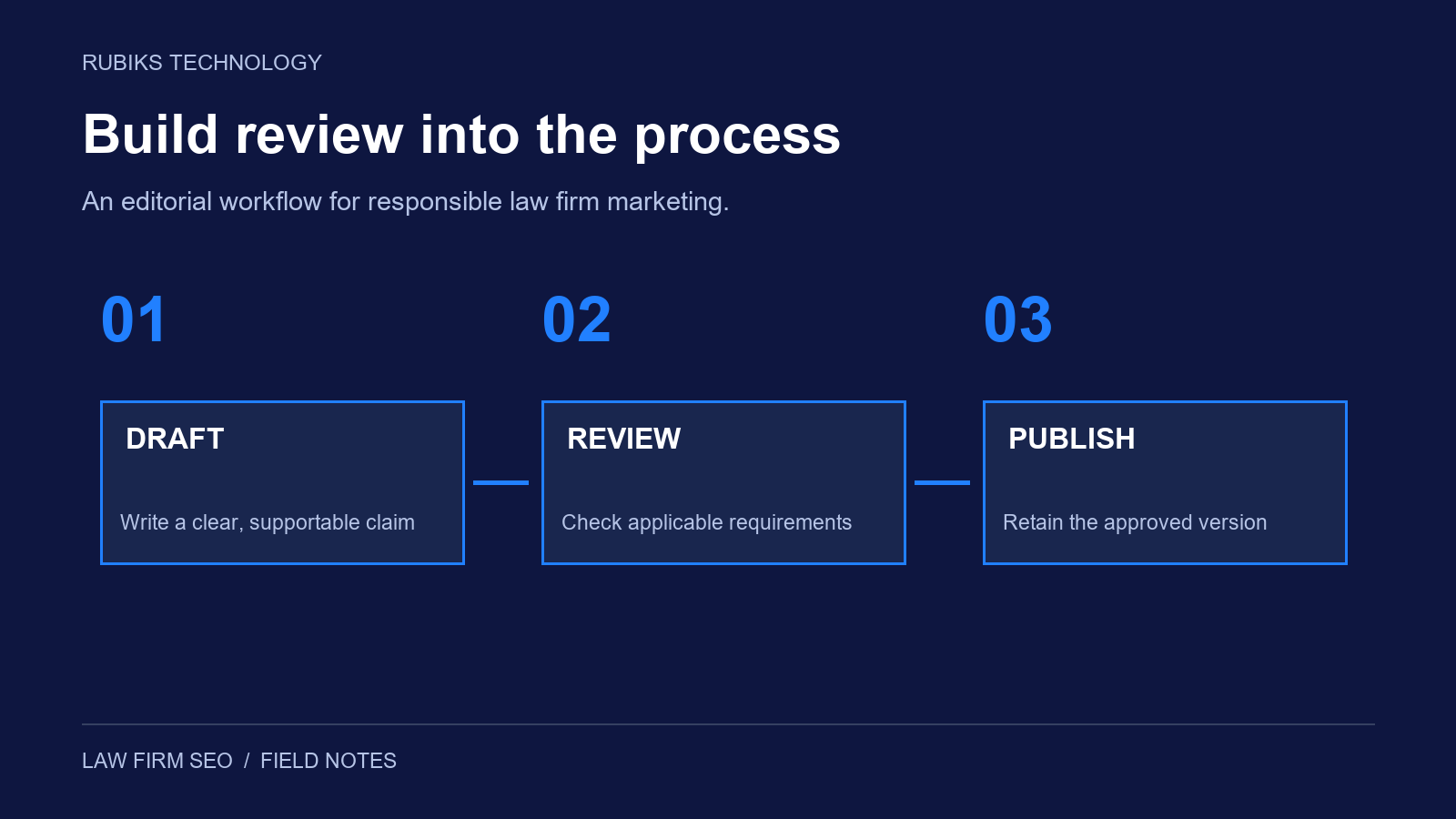
Knowing the rules is not the same as having a system that applies them, and the firms that stay clean are the ones with a workflow rather than good intentions. The workable version is lighter than most owners fear. Every piece of public-facing marketing, pages, ads, emails, social posts, and review requests, passes through a single named reviewer before publication. That reviewer works from a one-page checklist built on your state’s actual rules, covering superlatives, results language, specialist claims, disclaimers, and required labels. Most items take a minute to check. The checklist gets reviewed against bar rule changes once a year, because these rules do move, and several states have amended their advertising provisions in the last few years.
Keep an archive of what ran and when. Several states formally require retention of advertisements for a defined period, but even where it is not required, the archive is what saves you when a grievance arrives eighteen months after a campaign ended. A shared folder with dated exports of every page version, ad creative, and email template costs nothing to maintain and converts a panicked reconstruction into a ten-minute retrieval. Vendors should be contractually obligated to feed this archive, and the obligation should survive the relationship, since the complaint often outlives the contract.
Finally, put compliance language into every marketing vendor agreement. The contract should state which party reviews content against bar rules, require the vendor to flag rather than publish anything borderline, and give the firm final approval on all public copy. Agencies that push back on those terms are telling you how they plan to operate.
How compliance and SEO reinforce each other
The overlap runs deeper than most owners expect. Google’s quality systems reward accurate, verifiable, experience-backed content, and bar regulators require accurate, verifiable, non-misleading content. Substantiated claims, named attorneys with real bios, honest case result presentation, and precise practice descriptions serve both masters at once. In our law firm SEO agency work, compliance review is a stage in the content pipeline, not an afterthought, because retrofitting compliance onto published rankings-bearing pages is far more expensive than building it in.
There is also a competitive angle that gets overlooked. In markets where the loudest advertisers routinely skate along the edge of the rules, a firm whose marketing is specific, sourced, and restrained stands out to exactly the clients most firms want, the careful ones with real cases who research before they call. Compliance done properly is not a brake on growth. It is a positioning choice that filters for better clients while competitors chase volume with claims they cannot back up, and it removes an entire category of risk from the firm’s growth engine at the same time.
Market hard without betting your license
If you cannot say with confidence that every page, ad, and review request your vendors produce would survive a bar regulator’s reading, that uncertainty is a liability you do not need to carry. Our compliance-first approach builds marketing that wins cases and survives scrutiny in every state you practice. To get a compliance-aware read on your current marketing, explore our ABA compliant SEO for law firms service and book a strategy call with the Rubiks Technology team.